
Here’s the thing about solar advice online: most of it is quietly out of date.
You’ll read a glowing piece about fat tax credits and quick payback, glance at the date, and realize it was written when the rules were completely different. The numbers feel right. They’re just wrong now.
Because 2026 isn’t 2023. The economics shifted, and not in your favor. So if you’re sitting on a quote — or just wondering whether panels make sense for your place — let’s walk through what actually changed and whether it’s still worth doing.
The Big Thing Nobody Wants to Say Out Loud: Your 30% Discount Is Gone
For the better part of two decades, going solar came with a generous federal sweetener: thirty percent of your system cost, knocked straight off your tax bill. People called it the Residential Clean Energy Credit, or just “the solar tax credit,” or Section 25D if they wanted to sound like an accountant. Whatever the name, it’s what pushed a lot of fence-sitters into finally pulling the trigger.
That credit is gone.
The One Big Beautiful Bill Act, signed in July 2025, retired it roughly a decade ahead of schedule. Buy a system in 2026 and own it outright, and the federal government now kicks in exactly nothing. No slow wind-down, no partial credit for being early. The door shut on December 31, 2025, and that was that.
To put a number on it: on a $30,000 install, that credit used to hand you about $9,000 back. Now it doesn’t. A system you buy this year costs you something like 40% more out of pocket than the identical setup did in 2024 — same panels, same labor, just no government check softening the landing.
I’m leading with this because it reframes everything else. The decision used to be close to automatic; now it’s situational. Anyone still pitching panels as a guaranteed slam dunk is hoping you haven’t read the news.
One Side Door: Leases and PPAs
There is a loophole, sort of, and it’s worth understanding before you write the whole thing off.
The credit didn’t vanish for everyone — only for homeowners who buy and own their panels. Leases and power purchase agreements work differently. In those deals, a solar company owns the hardware on your roof, and they can still claim a commercial version of the credit (Section 48E). The pitch is that they grab the incentive and pass some of it back to you as a cheaper monthly rate.
Sometimes that works out fine. Sometimes the savings mostly stay in the company’s pocket and you’ve signed a 20-year contract for the privilege of finding out.
A few honest caveats. You won’t own the system — you’re renting your roof out — and whatever you save hinges on how square the company plays it. That credit is also set to tighten after 2027, so the lease angle is on a clock too. Still, if you’re short on cash or never had the tax liability to use the old credit anyway, a lease can pencil out. Just read the contract like it’s trying to trick you, because the bad ones are.
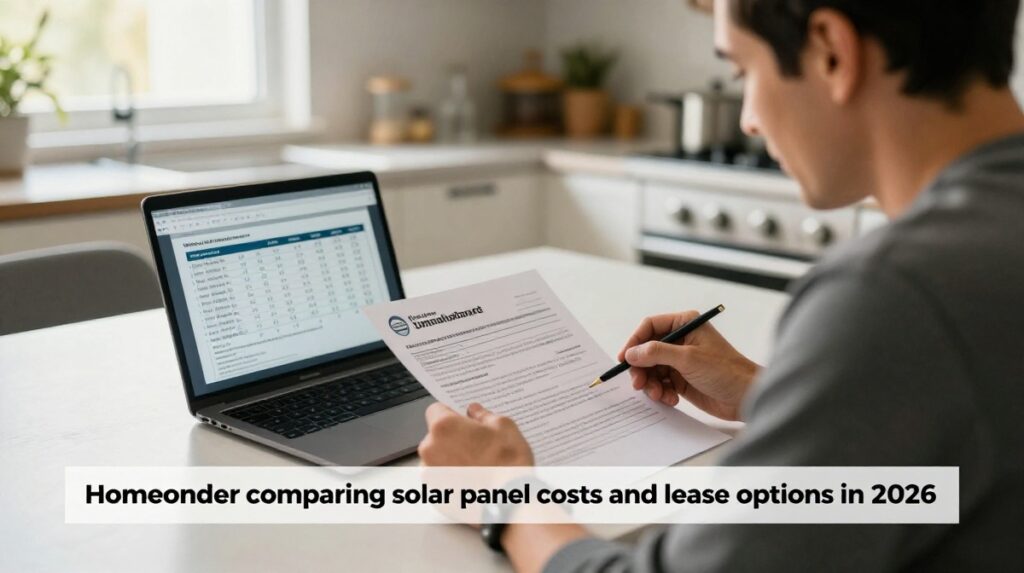
What Solar Actually Costs in 2026
Let’s talk real money.
Right now a residential system runs around $2.50 to $3.50 per watt installed, before any state programs come into play. Most houses end up in the 8-to-12 kilowatt range, depending on how much electricity they chew through.
In plainer terms: a typical 8 kW system lands near $24,800. Bump up to 12 kW and you’re looking at roughly $30,500. Go smaller — say 6 kW for a modest home — and it’s more like $15,000 to $18,000. And those are “before incentives” prices, which used to be misleading because the federal credit lopped so much off the top. Now that the credit’s dead, “before incentives” is uncomfortably close to “what you’ll actually be writing checks for.”
Something the reps mumble past: the panels themselves are the cheap part — often a fifth or less of the total. The rest is labor, the inverter, the racking and wiring and mounting, the permits, the utility hookup fees, and the installer’s cut. Which is why two quotes for the “same system” can land thousands apart. You’re not just buying glass and silicon; you’re buying a crew that won’t botch the roof penetrations and a company that’ll still pick up the phone in 2034.
One more word on financing. Those tempting “$0 down” loans often fold a hefty dealer fee — sometimes pushing 20% — into the amount you borrow. The monthly payment looks painless; the total you repay does not.
READ MORE 9 Energy-Saving Upgrades That May Reduce Utility Bills
READ MORE Homeowners Are Spending More on Repairs — Here’s Why
The Only Question That Really Matters: Does It Pay Off?
Strip away the green-energy poetry and solar is just a wager. You’re betting the panels save you more on electricity over their lifetime than they cost to put up. So — does the bet win?
For plenty of households, still yes. Even now.
Payback periods these days run about 10 to 12 years for an average install. In states where power is genuinely expensive, that can shrink to under 8. In the very best markets, people break even in 5 to 7 years and then ride out two more decades of cheap electricity.
Across the full 25-year life, the savings can be substantial — though the range is enormous. A modest system in a cheap-power state might net you around $11,000. A well-sized one in a sunny, high-rate market can clear six figures. That’s just how wide the spread gets once geography enters the room.
The reason solar still works without the tax credit comes down to one stubborn idea: you’re locking in your cost of power. Generate your own and it pencils out to roughly 6 to 8 cents a kilowatt-hour over the system’s life. Your utility charges somewhere between 14 and 30 cents — and that number has a nasty habit of creeping up year after year. You’re betting that grid power keeps getting pricier, which is about the safest bet going.
Net Metering Quietly Decides Everything
If cost is the first lever, this is the second — and it’s the one most articles bury near the bottom, if they mention it at all.
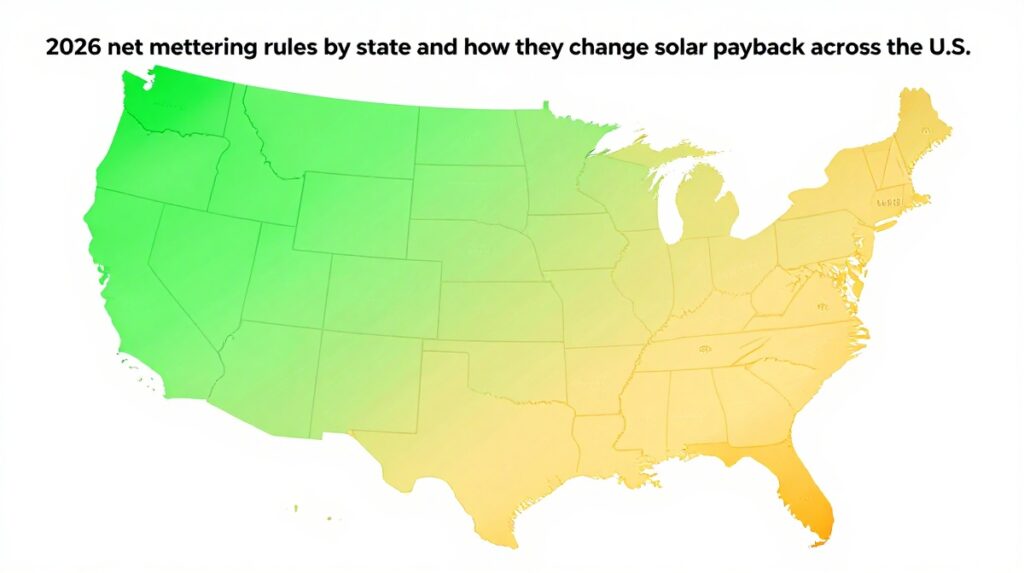
Net metering governs how your utility pays you for the surplus power your panels shove back onto the grid. The catch is that the rules swing wildly from one state to the next, and they matter enormously.
You’ll run into one of two setups. The good one is full retail net metering, where every kilowatt-hour you export earns you the same rate you’d pay to buy it — a clean one-for-one swap. Massachusetts, New Jersey, Maryland, Vermont, and Oregon still play it this way, and in a place like Massachusetts that credit sits around 30 cents a kilowatt-hour. Lovely deal.
The rougher setup is net billing, where exports earn you the utility’s “avoided cost” — pennies, basically. California’s NEM 3.0, fully in effect for 2026, is the poster child. It chopped export credits by roughly 75%, dragging them down to something like 5 to 8 cents from the old 30.
Sit with how big that gap is. The same 10 kW system can pay back nearly a decade faster in New Jersey than in California, for no reason other than how each state counts the power you send back. Same panels, more or less the same sun, totally different answer.
So before a quote gets you excited, find out which rulebook your utility follows. It reshapes the entire calculation.
Do You Actually Need a Battery?
Depends — and it depends on that net metering rule we just covered.
In a full-retail state, the grid basically acts as a giant free battery. You bank credits all afternoon while the sun’s up, then draw them back after dark at the same rate. In that situation you can often skip the battery entirely and keep several thousand dollars in your pocket.
Under net billing, the logic flips. Exporting midday power for pennies is a lousy trade, so you’d rather hang onto that electricity and spend it yourself in the evening when rates climb. That’s what a battery does. They aren’t cheap — but under something like NEM 3.0, solar plus storage pulls payback back down to around 7 or 8 years, which beats dumping cheap power onto the grid all day for nothing.
There’s a second reason people spring for one, and the spreadsheet never quite captures it: when the grid goes dark, you don’t. A battery keeps the fridge cold, the router blinking, the heat running. If you live somewhere the power flickers out a few times a year, that peace of mind is worth real money.
My honest read: don’t buy storage you don’t need just because a rep waved it under your nose. But in a net-billing state, it’s stopped being optional if you want the numbers to land.
When It’s a Slam Dunk, and When It’s a Mistake
Let me make this easy to gut-check against your own situation.
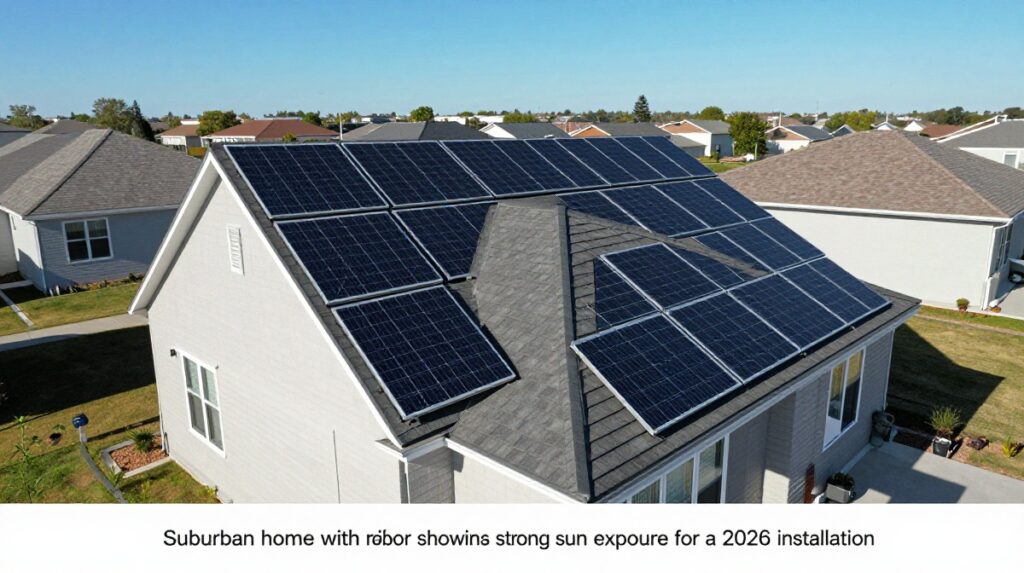
Solar tends to be a strong move when several of these line up: a hefty electric bill, expensive local power, a south- or west-facing roof without much shade, a roof in good shape that’s not due for replacement, plans to stay put at least eight to ten years, and a state that still does full retail net metering. The more boxes you tick, the more obvious the call.
It gets shakier — sometimes it’s an outright mistake — when the opposite is true:
- Your roof is old. Pulling panels off to swap shingles in a few years is a miserable, expensive job.
- Trees or a neighboring building throw shade across the roof for big chunks of the day.
- Your electricity is already cheap, which stretches the payback into something glacial.
- You’re planning to move soon and might not own the thing long enough to break even.
- You’re tempted to sign a lease you don’t really understand just to land “free” panels.
Be straight with yourself about which column you fall in. The condition of your roof and the sun it catches matter a whole lot more than whatever’s printed in the glossy folder the salesperson left on your counter.
How Long Do They Last, and What Goes Wrong?
People fixate on the upfront price and wave off the next quarter-century, which is backwards.
Modern panels are durable. Most ship with 25-year production warranties and keep going past that, shedding maybe half a percent of output a year — so a panel installed today is still cranking out 85 to 90% of its power well into the 2040s. The part that actually wants attention is the inverter: string inverters tend to give out around the 10-to-15-year mark, and a replacement runs roughly $1,000 to $2,500. Microinverters generally last longer, closer to the panels themselves.
Day-to-day upkeep is light, almost suspiciously so. Rain handles most of the cleaning, and there are no moving parts to grind down — an occasional rinse if you’re somewhere dusty, a checkup every few years to confirm it’s still producing. So when you sketch out your payback math, pencil in one likely inverter swap and drop the “set it and forget it” fantasy. It’s low-maintenance. It isn’t no-maintenance.
How to Do This Without Getting Fleeced
Decided you’re in? Go in with your guard up, because this industry has more than its share of smooth talkers and padded quotes.
Get at least three quotes — full stop. Bids for the same system routinely swing by thousands, and you won’t know what fair looks like until you’ve seen a few. Lean toward a local installer over a national outfit that knocked on your door; the local shops usually price better and actually show up when something breaks years later.
Watch the system size, too. A rep on commission has every reason to upsell you panels you’ll never fully use, and oversizing is especially wasteful under net billing. If a lease or PPA is on the table, read the fine print like your wallet depends on it — and zero in on the escalator clauses, the ones that quietly nudge your payment up 2 or 3% a year and eat the savings you were promised.
A couple more. Dig around for state and local incentives before you sign — rebates, property-tax exemptions, and SREC programs still exist in plenty of places, and the installer won’t always volunteer them. And if your roof has fewer than ten years left, replace it first. I can’t stress that enough.
Mostly, just slow down. This is a 25-year commitment, not a flash sale. Any rep leaning on you to sign tonight is working an angle, and it isn’t yours.
So, Bottom Line
Should you put solar on your roof in 2026?
It’s no longer the automatic yes it was a couple of years back. Losing that 30% federal credit raised the bar, and now you have to clear it with the specifics of your own situation rather than just assuming the math works out.
The short version: if you’ve got high electric rates and full retail net metering, solar is still a strong yes — credit or no credit — because payback comes fast and the long-haul savings are real. If your power is cheap, or you’re stuck under net billing without a battery, ease off and run the numbers again before you commit; storage or a well-structured lease might rescue the economics, or might not. And if you’re dealing with an aging roof, heavy shade, or a move on the horizon, it’s probably not your moment — and that’s okay.
One last thing, because I hear it constantly: don’t talk yourself into “I’ll just wait for it to get cheaper.” The federal credit isn’t coming back. Utility rates aren’t about to fall. Waiting mostly means handing your power company more money while you dither on the porch.