
Home Security System Cost: What You’ll Really Pay in 2026
Here’s the honest answer nobody leads with: there is no single price for a home security system. Anyone who quotes you one flat number is either guessing or selling something.
I’ve watched people spend $80 once and never pay another dime — and I’ve watched neighbors lock themselves into five-year contracts that quietly cost north of $2,000 by the end. Same goal, wildly different bills. The difference comes down to a handful of choices you get to make, and most of them are easier to understand than the industry would like you to believe.
So let’s actually break it down. Real numbers, real ranges, and the hidden fees that turn a “cheap” system into an expensive surprise. By the end you’ll be able to sketch your own budget on the back of an envelope and walk into any sales pitch knowing exactly what’s fair.
The Three Costs Inside Every Home Security Bill
Strip away the marketing and every system — ADT, Ring, SimpliSafe, whatever — is built from the same three cost buckets:
- Equipment. The physical hardware: control panel, sensors, cameras, the works. Usually a one-time purchase.
- Installation. Either you do it yourself for free, or you pay a pro.
- Monitoring. The monthly fee for someone (or something) to watch the system and respond.
Get a handle on those three and you understand the entire cost of home security. Everything else is a variation on the theme.
Home Security System Cost at a Glance (2026)
Before we go deep, here’s the big picture. Industry data from 2026 puts a typical installed system somewhere around $600 to $750 all in, though that number hides an enormous range depending on the route you take.
| Cost Component | Typical Range (2026) | Notes |
|---|---|---|
| Equipment (one-time) | $100–$600 for DIY kits; up to $2,500+ for large smart homes | Financing often available |
| Professional installation | $0–$200 (commonly $99–$199) | DIY is free; wired setups cost more |
| Monitoring (monthly) | $0–$20 self-monitored / $20–$60 professional | Ongoing — the biggest long-term cost |
| Starter-kit average | ~$200 equipment + ~$25/mo for pro monitoring | Per NerdWallet’s 2026 analysis |
The headline takeaway? Upfront cost matters far less than the monthly fee. A $30-a-month plan looks harmless until you do the math: over three years, that’s more than $1,000 on monitoring alone. The recurring number is the one that quietly decides your total.
Equipment: From a $100 Starter Kit to a $3,000 Smart Fortress
Equipment is where your budget starts, and the spread is huge.
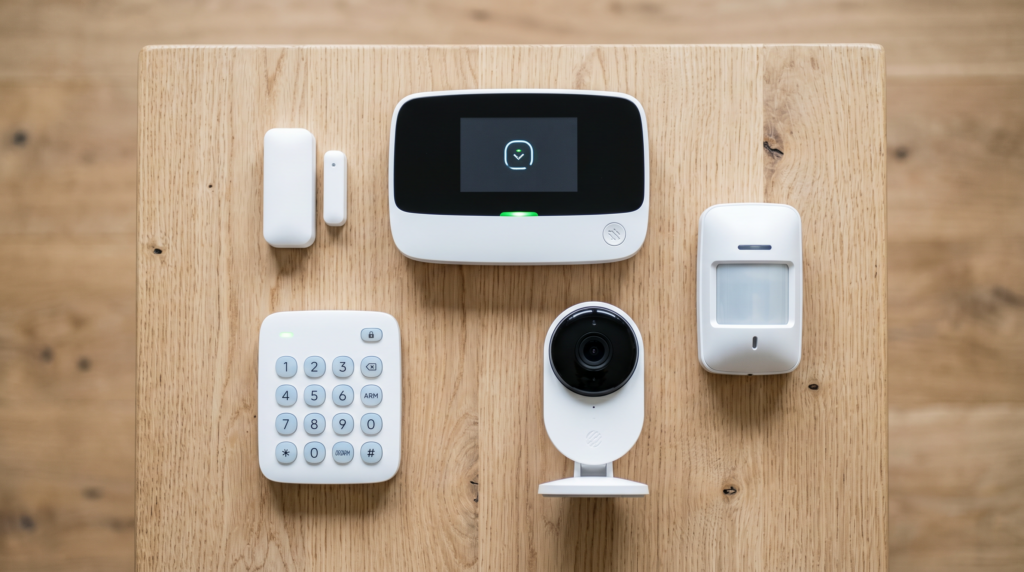
A basic DIY starter kit runs roughly $130 to $500. NerdWallet pegs the average starter kit at a little over $200, and that gets you the essentials: a base hub, a couple of door/window sensors, usually a motion sensor, and maybe a keypad or key fob. For a small home, an apartment, or a condo, that’s genuinely enough to cover your main entry points.
Then the add-ons start calling, and the total climbs fast.
Building Out Your System, Piece by Piece
Think of these as a menu. You’re rarely forced to buy everything — pick what fits your home’s layout and real risks.
| Component | Approx. Price (each) |
|---|---|
| Extra door/window sensor | $10–$20 |
| Motion sensor | $20–$40 |
| Indoor camera | $30–$100 |
| Outdoor camera | $50–$200 |
| Video doorbell | $50–$200 |
| Smart lock | $100–$250 |
| Glass-break / smoke / CO / water sensor | $20–$50 |
Load up on cameras, a video doorbell, and a couple of smart locks and you’re easily looking at $700 to $1,200. Go all-in on a large home with whole-property video and home automation, and equipment alone can reach $1,500 to $3,000 or more. None of that is wrong — it’s just a different tier. The trick is buying for your house, not for the brochure.
One practical money tip: many providers discount bundles heavily. A five-piece Ring kit, for example, has sold for around $200 — roughly $45 cheaper than buying those same pieces separately. And if you can wait, holiday sales routinely knock 30–50% off equipment.
Installation: Free DIY vs. $99–$200 for a Pro
This is the first real fork in the road, and it shapes your whole financial picture.
DIY installation costs nothing. Modern wireless systems — Ring, SimpliSafe, Cove, Abode — use peel-and-stick sensors and a plug-in hub. Most people finish setup in 30 to 60 minutes with the app walking them through it. No technician, no fee.
Professional installation typically runs $99 to $199. ADT starts around $99; Vivint around $199. If you’ve got a complex or hard-wired setup, that figure can climb — Angi reports installation reaching $120 to $600 for more involved jobs, and full wired systems that require drilling and running cable through walls can hit $800 to $1,600.
Here’s the catch worth tattooing on your hand: sometimes installation is advertised as “free.” It usually isn’t. That free install — and even free equipment — tends to be baked into a multi-year monitoring contract. You’re not skipping the cost; you’re spreading it across 36 to 60 months of higher monthly fees. Not necessarily a bad deal, but know what you’re signing.
Sloppy DIY placement can leave gaps, though. If you’re going the do-it-yourself route, it’s worth learning where systems commonly fail first — our breakdown of the home security mistakes that make a burglar’s job way too easy will save you from the obvious blind spots.
Monitoring: The Cost That Never Stops
Equipment is a one-time hit. Monitoring is forever — which is exactly why it deserves the most thought.
You’ve got two broad paths:
| Monitoring Type | Monthly Cost | Who Responds? |
|---|---|---|
| Self-monitoring (basic) | $0 | You — alerts hit your phone |
| Self-monitoring + cloud video | $5–$20 | You, with recorded footage |
| Professional (basic) | ~$18–$30 | A monitoring center contacts you / dispatches help |
| Professional (premium/smart) | $40–$80+ | Monitoring center, plus video analytics and automation |
With self-monitoring, your system pings your phone when something trips, and it’s on you to call 911. It’s free or close to it. The tradeoff is obvious: if you’re asleep, on a plane, or just miss the notification, nobody’s coming.
With professional monitoring, a central station gets the alert around the clock, tries to reach you, and dispatches police or fire if needed. Expect roughly $20 to $60 a month, with the sweet spot landing around $25 to $40. The cheapest pro plans go lower — Cove starts near $18, and ADT’s self-install line begins around $10 for DIY monitoring — while feature-heavy plans with video and full automation push toward $80 or beyond.
Do the three-year math before you commit. A $30 plan is over $1,000 across 36 months. A $45 plan is more than $1,600. That recurring fee, not the equipment, is where the real spending lives.
DIY vs. Professional: Which Actually Costs Less?
This is the question everyone’s really asking, so let’s put numbers to it over a realistic five-year window.
Path A — DIY, self-monitored. Buy a $250 kit, monitor it yourself for free. Five-year cost: about $250, plus the occasional camera or battery. Cheapest option by a mile, but you’re the safety net.
Path B — DIY, with pro monitoring. That same $250 kit plus $25/month professional monitoring. Five-year cost: roughly $1,750. You own your gear outright and can usually cancel anytime, but you pay for peace of mind.
Path C — Fully professional (Vivint/ADT style). Often low money down on equipment, then $40/month on a contract. Five years at $40 is $2,400 in monitoring alone, on top of any financed hardware. The most hands-off — white-glove install, premium service — and the most expensive.
There’s no universally “right” pick. If you’re home most of the time and comfortable handling alerts, Path A is hard to beat. Travel constantly or want zero hassle? Path C earns its premium. Most households land happily in the middle with Path B.
The Hidden Costs Nobody Puts on the Quote
This is where budgets get blown. The sticker price is rarely the final price, so factor these in:
- Alarm permits. Many cities require you to register a monitored system. Permits typically run $25 to $100, sometimes with an annual renewal fee.
- False alarm fines. Trip the system by accident enough times and your city may start charging you for police or fire response. These add up quietly.
- Activation fees. Some companies tack on a one-time activation charge to start service.
- Financing interest. Spreading equipment over 36 to 60 months is convenient, but it’s a loan — read the rate.
- Early termination fees. Break a contract early and you may owe a chunk of the remaining balance.
- Cloud storage. Video history often costs extra, frequently $3 to $20 a month per camera tier.
- Cellular backup. Keeps your system online during Wi-Fi or power outages, sometimes bundled, sometimes an add-on.
Before you sign anything, slow down and read the contract — all of it. The Federal Trade Commission’s guide on how to avoid scams when shopping for a home security system is a genuinely useful, no-nonsense read; it covers the “free equipment” trap, high-pressure door-to-door tactics, and the questions to ask before you commit. Five minutes there can save you hundreds.
What Popular Systems Cost in 2026
To turn ranges into something concrete, here’s where some of the best-known names land. Treat these as ballpark figures — pricing shifts with promotions and packages.
| System | Starting Equipment | Monitoring (per month) | Contract? |
|---|---|---|---|
| Wyze | $20–$50 per camera | $0 (self-monitored) | No |
| Ring Alarm | ~$200 (5-piece kit) | $0 self / ~$10 pro add-on | No |
| Cove | From ~$149 | From ~$18 (pro) | No |
| SimpliSafe | ~$250 | From ~$22 (pro; self available) | No |
| ADT (Pro Install) | $325–$1,500 | From ~$25 | Typically yes |
| Vivint | $350–$3,000 | From ~$30 | Yes (financing) |
Notice the pattern: the no-contract DIY brands ask more upfront and less long-term, while the white-glove names flip that equation. Neither is a trap — they’re just built for different buyers.
And don’t sleep on regional or lesser-known providers. They don’t buy national ad campaigns, but they’re sometimes the best value in your specific area.
How to Spend Less Without Skimping on Safety
You can get strong protection without overpaying. A few moves do most of the heavy lifting:
- Start small and expand. A hub, three door sensors, and one camera covers most homes. Add pieces later as the budget allows.
- Choose no-contract where you can. SimpliSafe, Ring, Cove, and Abode let you cancel anytime — no early-termination landmine.
- Self-install. Skipping pro installation saves $100 to $200 instantly on most DIY systems.
- Buy during sales. Black Friday, Prime Day, and brand anniversaries routinely bring 30–50% off equipment.
- Ask about every discount. Military, senior, first-responder, and bundle discounts are common — and rarely advertised.
- Claim your insurance discount. Many home insurers shave money off your premium for a monitored alarm. Call your insurer right after installing; some even apply it retroactively.
- Lean on smart devices that prevent claims. Water-leak and smoke sensors catch disasters early. Several of the smart home upgrades homeowners love in 2026 pull double duty — protecting your home and trimming costs.
For more guides like this on getting the most from your home budget, the cost guides section is worth a browse.
So, What Should You Actually Budget?
Let me make this concrete with three honest scenarios:
- Apartment or small home, tight budget: A basic DIY kit ($150–$250) with free self-monitoring. Real cost: under $250, then near-zero monthly. Add a camera or two as you go.
- Average family home, wants backup: A mid-range DIY kit ($250–$400) plus professional monitoring around $20–$30/month. Roughly $300 upfront and $300–$360 a year — solid, balanced protection.
- Large or high-tech home, wants hands-off service: A professionally installed system with whole-home video and automation. Plan for $1,000–$3,000 in equipment (often financed) and $40–$60/month. Premium protection, premium price.
Whatever route you pick, remember the real value proposition. FBI crime data puts the average loss from a single burglary at well over $2,600 — to say nothing of the broken-into feeling that lingers long after the stuff is replaced. Against that, even a modest monthly fee starts to look less like a cost and more like cheap insurance. If you want to dig into the numbers yourself, the FBI’s Crime Data Explorer is the official source.
One last bit of straight talk: prices in this space change constantly, promotions come and go, and local permit rules vary by city. Use these ranges as your map, then pull two or three current quotes for your specific home before you commit. Get the equipment right, choose a monitoring level that matches how you actually live, and read every line of the contract — do that, and you’ll pay a fair price for real peace of mind.
5. FAQ
How much does a home security system cost per month? Monthly costs depend entirely on monitoring. Self-monitoring is free to about $20 a month if you add cloud video. Professional 24/7 monitoring typically runs $20 to $60, with most plans landing around $25 to $40. Premium plans with video analytics and home automation can reach $80 or more.
How much does it cost to install a home security system? DIY installation is free — modern wireless kits use peel-and-stick sensors you set up in under an hour. Professional installation usually costs $99 to $199, though complex or hard-wired jobs can run higher. Be cautious of “free” installation, which is often tied to a multi-year monitoring contract.
Is a home security system worth the cost? For most homeowners, yes. FBI data puts the average burglary loss at over $2,600, and a monitored system can deter break-ins entirely. Many insurers also discount your premium for a monitored alarm, which offsets part of the monthly fee. Weighed against the cost of a single incident, even a modest plan often pays for itself.
Can you get home security with no monthly fee? Yes. Brands like Ring, Abode, and Wyze offer self-monitored systems with no required subscription — alerts go straight to your phone. The tradeoff is that no monitoring center will call 911 for you, so you’re responsible for responding to every alert yourself.
What is the cheapest home security system? For a truly minimal setup, standalone Wyze cameras ($20–$50 each) with free self-monitoring cost almost nothing ongoing. Among professionally monitored options, Cove is among the most affordable, with equipment starting near $149 and monitoring around $18 a month.
Does a home security system lower home insurance? Often, yes. Many home insurers offer a discount for a monitored security system, and the savings can be meaningful over time. Call your insurance company right after installation to ask about the discount and what documentation they need — some will even apply it retroactively.