
A guy called me one October. Said he had a “tiny brown spot” on his bedroom ceiling, nothing serious, just wanted a quote whenever I got a chance.
By the time I got up into his attic, the rafters were black. Soft to the touch. That little spot had been leaking through the better part of two winters, and what should’ve been a Saturday afternoon repair turned into new decking, new insulation, and a five-figure invoice.
That’s the thing about roofs. They don’t shout. They whisper, and most folks never learn the language.
So let’s fix that. Here’s how to read yours before it empties your bank account.
Why “I’ll Deal With It Later” Is a Trap
Water doesn’t sit still. Ever.
It slips in through a gap you’d never spot, then it travels — sideways along a beam, down inside a wall cavity, into the pink insulation where it just sits and stews. A leak the size of a dime can ruin an entire ceiling, and you won’t see most of the damage until it’s already done.
What you’re really buying when you wait:
- Mold. The kind that hides behind drywall and gets the whole family coughing.
- Rot in the framing, which quietly turns a shingle job into a carpentry job.
- Soggy insulation that stops insulating, so your heating bill climbs for no obvious reason.
- And if the water reaches the wiring up there? Now it’s a fire risk, not just a stain.
Cheap today. Brutal in six months. Roofs don’t reward you for putting things off.
READ MORE Should You Install Solar Panels in 2026?
The Stuff You Can See From Your Own Driveway
You can catch most of this without leaving the ground, honestly. Grab a pair of binoculars. Walk a slow lap around the house and actually look up for once.
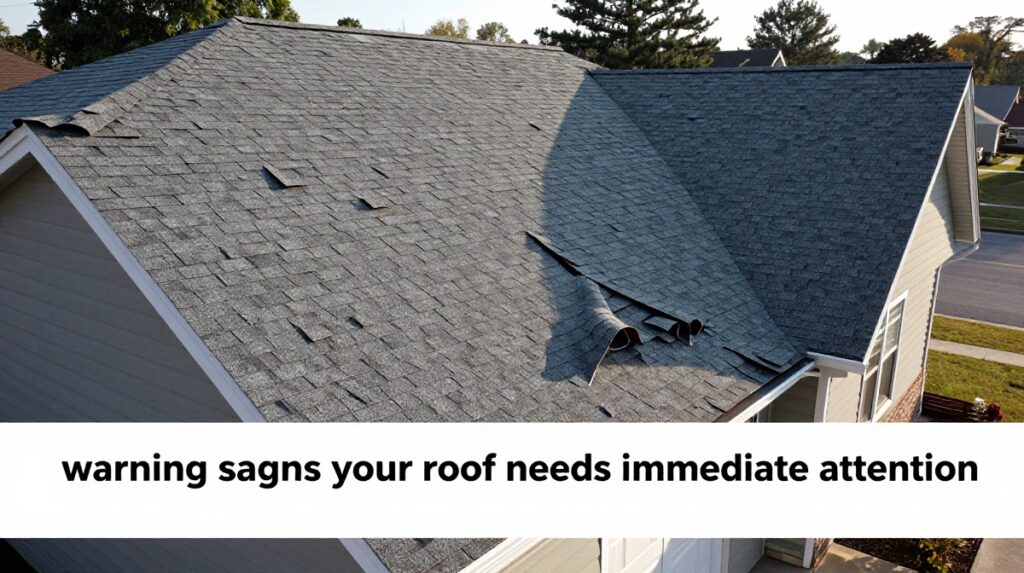
Shingles That Are Curling, Cracked, or Just Gone
Easy one. People still drive past it every single day.
Healthy shingles lie flat and tight, like they’re glued down. When they start lifting at the corners, curling at the edges, or vanishing in patches, your roof is losing its skin. Curling usually means age — they’ve dried out and shrunk. Bare gaps usually mean wind got underneath and peeled them off like a sticker.
Either way, the waterproof layer beneath them is now wide open. And it was never built to be.
A Roofline That Isn’t Straight Anymore
Back up to the curb and sight down the ridge, that long top edge of the roof. Straight as a ruler? Good. A dip, a sag, a soft wave in the middle? Not good.
Call somebody today. I mean today.
A sagging ridge means something structural has given out underneath — rotted plywood, tired rafters, or the sheer weight of two or three old roofs stacked on each other. This is not a “keep an eye on it” situation. Sagging roofs are the ones that come down.
A Gutter Full of Black Grit
Go peek inside your gutters. That coarse black sand pooled in the bottom, the stuff that looks like spilled pepper? Those are your shingle granules.
A brand-new roof sheds a few. Fine. But scoop out a handful and you’ve got trouble, because those granules are the sunscreen for your shingles. Strip them off and the shingle bakes in the UV, dries out, and starts to crack. Look up and you’ll often see the bald, shiny patches that match the grit you just found down below.
Flashing That’s Rusted or Pulling Away
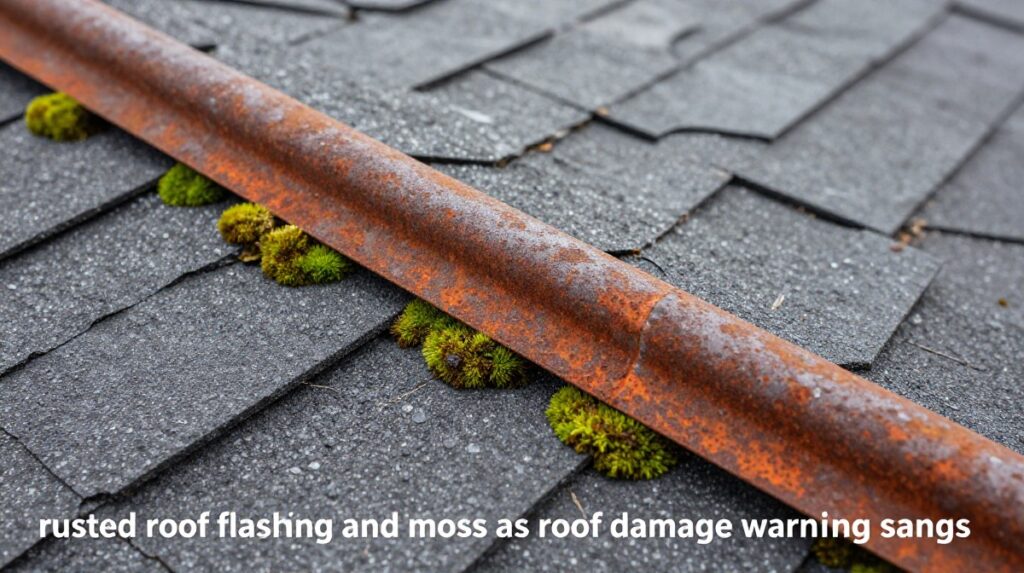
Flashing is the thin metal that seals all the awkward joints — where the chimney pokes through, around the plumbing vents, down in the valleys where two slopes collide.
Hardest-working metal on the whole roof. Usually the first to quit, too.
Hunt for rust, daylight gaps, sealant that’s cracked and lifting. And here’s a fact that catches people off guard: most leaks don’t start out on the open shingles at all. They start right here, at the flashing, where water collects and waits for a weak spot.
Soft Trim Boards and Drooping Gutters
Now look at the very edge of the roof, where the gutter clamps on.
That horizontal board behind the gutter is the fascia. The panel tucked under the overhang is the soffit. When water sneaks in at the edge, these two rot first — so soft, flaky, paint-peeling trim is basically a confession that you’ve been leaking for a while. Gutters that sag or pull off the wall only speed it up, since now the water isn’t draining where it’s supposed to.
Moss and Those Long Black Streaks
A patch of green moss looks kind of charming. On a roof, it’s quietly chewing things up.
Moss works like a sponge, pinning moisture against the shingles. Come winter, that trapped water freezes, swells, and pries the shingles up from below. The dark vertical streaks are a different animal — an algae, mostly cosmetic — but thick moss in a wet climate is the real threat.
Whatever you do, leave the pressure washer in the garage. You’ll blast the granules clean off and swap one problem for a worse one.
The Warnings That Show Up Indoors
This is the part people miss entirely. Some of the loudest roof problems never appear on the roof at all. They show up inside the house.
Stains Creeping Across the Ceiling
A brown ring. A yellowish blotch. Some shape on the ceiling that definitely wasn’t there at Christmas.
That’s water that already won. It got past your roof and it’s pooling in the ceiling right now. Press on it — if it’s soft, or it’s spreading, you’ve got an active leak, not an old scar. And please don’t just roll a coat of paint over it. It’ll bleed right back through, darker, the next time it rains.
A Musty Attic
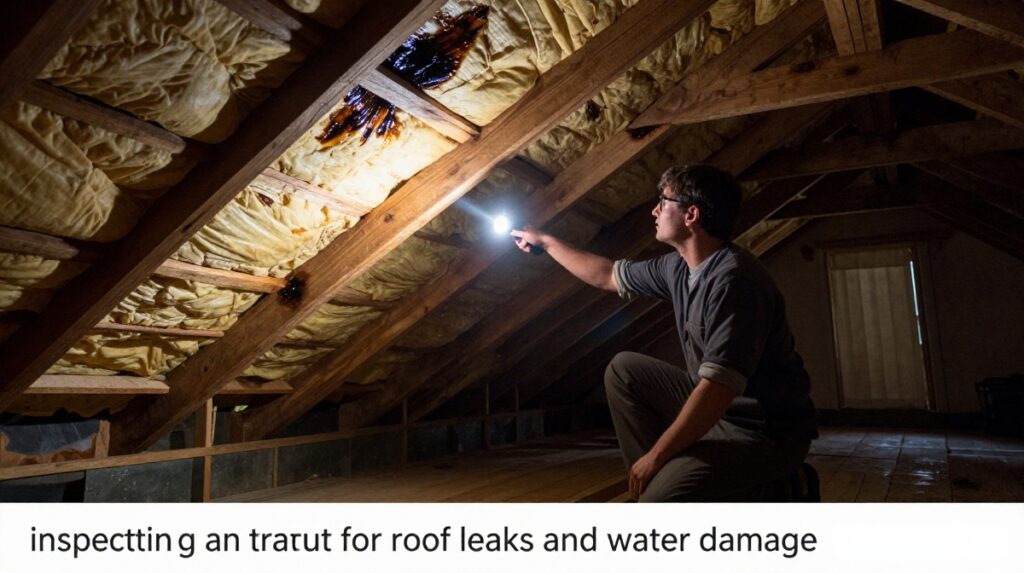
Your attic doesn’t lie. Climb up with a flashlight on a clear day and just look around.
Dark trails running down the wood. Insulation that’s matted and damp instead of fluffy. A smell like a wet basement or soggy cardboard. A dry, healthy attic basically smells like nothing — so if your nose says something’s off, trust it.
Daylight Where There Shouldn’t Be Any
Simplest test going. Sunny afternoon, switch off the attic light, and look up at the underside of the roof.
Little pinpricks of sunlight poking through? Those are holes. And anything that lets light in lets rain, snow, and cold air in too. Mark them, seal them, and do it before the next storm finds them for you.
A Heating Bill That Keeps Climbing
Your energy costs jumped and you didn’t change a thing. Strange, right?
A lot of the time it traces straight back to the roof. Bad ventilation plus waterlogged insulation means the house can’t hold its temperature. Heat bleeds out in January, the cool air leaks away in July, and your furnace or AC just grinds along trying to keep up. A roof problem can hit your wallet months before it ever drips on your floor.
After a Storm, Get Out There Fast
Hail, hard wind, a branch coming down. That stuff does damage you can’t spot from the couch.
So walk the yard after any rough weather. Shingle fragments in the grass. A dented gutter. Fresh debris scattered up top. Hail especially leaves little bruises and dimples that won’t leak right away — they just sit there weakening the shingle for a year or two until, one day, they do.
Move quick on this part:
- Photograph everything from the ground and let the timestamp do its job
- Check the yard and gutters for loose granules and busted shingle bits
- Phone your insurer while it’s obvious the damage came from the storm
- Don’t sign a thing with any contractor until you’ve looked it over yourself
Insurers are skeptical of vague claims filed three months late. Document it early and the upper hand is yours.
Nobody Wants to Talk About Age
Roofs wear out. Yours has a clock running on it whether you’ve checked it or not.
A typical asphalt shingle roof gives you somewhere around 20 to 25 years. Past that, every storm is a coin flip. Dig out the install paperwork, or ask whoever owned the place before you.
Ballpark numbers worth keeping in your head:
- Asphalt shingles — roughly 20 to 25 years
- Wood shakes — closer to 25 to 30
- Metal — anywhere from 40 to 70
- Slate or tile — 50 to 100, sometimes longer
If every neighbor who built the same year you did is suddenly getting a new roof, read the room. You’re next in line.
How to Check It Without Ending Up in the ER
You can find most of this yourself. You absolutely should not break your neck doing it.
Work from the ground first. Binoculars, slow scan — every slope, the ridge, the flashing, the gutters. Circle the whole house so nothing hides on a side you skipped.
Then the attic. Bright day to catch daylight through the boards, then again right after a downpour to catch the actual drip in progress. Decent flashlight, and get your face close to the wood and the insulation.
Rules I don’t bend on:
- Wet, steep, or icy roof? Stay off it. No exceptions.
- Think the decking’s rotted? Then it can give way under you, so keep your weight off it.
- Not rock-solid on a ladder? Don’t climb. A broken hip costs more than any roofer ever will.
If something looks bad and you can’t reach it safely — that’s the precise moment to hand it to a pro.
Patch It or Replace It?
Not every problem means tearing the whole thing off. But some do, and a straight-shooting contractor will tell you which camp you’re in.
A repair is usually the right call when:
- It’s one small, contained spot
- The roof still has years left in the tank
- You’re looking at a handful of shingles or a run of flashing
Time for a full replacement when:
- The roof’s already at or past its age
- Leaks are popping up in three different rooms
- The deck underneath feels spongy or looks like it’s sagging
- You’ve patched the same roof so many times you’ve lost count
Pouring repair money into a dead roof is just lighting cash on fire. At some point you stop, take a breath, and start fresh.
Don’t Just Hire Whoever Knocks
The morning after a hailstorm, your street fills up with trucks and clipboards offering free inspections. Slow down here.
The good roofers in your town are already booked solid. A lot of the door-knockers chasing the storm do rushed, sloppy work and they’re three counties away before the leaks come back. Protect yourself.
Before any money changes hands:
- License and insurance — make them show you, don’t take their word for it
- The quote in writing, itemized, every number out in the open
- Real reviews and local references you can actually call
- A fair deposit is normal. The full amount upfront is not.
A solid roofer walks you through the problem in plain language and gives you room to think. Anybody pushing you to sign “right now, today, this price only” is selling pressure, not a roof.
A Few Habits That Buy You Years
A little upkeep beats a big repair every single time. And none of it’s complicated.
- Clear the gutters twice a year so the water has somewhere to go
- Cut back any branch hanging over or scraping the shingles
- Keep the attic ventilated — trapped heat and damp will roast a roof from the inside out
- Do a two-minute scan each spring and fall, and always after a storm
- Jump on the small stuff early, while it’s still small
Ten minutes of paying attention can save you thousands. I’m not being dramatic. That’s just the math of it.
So Here’s Where That Leaves You
Your roof has been trying to tell you something. The curled shingles, the grit in the gutter, that stain inching across the ceiling — that’s it talking. And it stays a monologue until you finally answer back.
Go look this week. Walk the yard, glass the roof with binoculars, stick your head in the attic with a flashlight. Catch the little problems while they’re still little.
Because the homeowner who checks this weekend writes a check for a repair. The one who keeps putting it off writes a much bigger one for a disaster.