
Your HVAC system is the most expensive appliance in your house. Most people ignore it until it dies. Then they hand over $7,000 for a new unit and wonder what went wrong.
Here’s the truth. Most breakdowns are preventable. A little attention a few times a year keeps your system running for fifteen, even twenty years. Skip it, and you’re lucky to see ten.
This is the full checklist. No fluff. Just the stuff that keeps your system alive and your bills low.

Why Bother With HVAC Maintenance?
Let me be blunt. A neglected system costs you in three ways.
First, your energy bill. A dirty filter or a clogged coil makes the system work harder. That’s wasted money every month. We’re talking 15% higher bills, sometimes more.
Second, repairs. Small problems grow. A $20 part you ignore today becomes a $900 compressor failure later. Happens constantly.
Third, lifespan. Maintained systems last far longer. That’s the gap between replacing your unit at year 20 versus year 9. You do the math on that one.
Then there’s safety. Furnaces burn gas. A cracked heat exchanger can leak carbon monoxide into your home. That’s not a money problem. That’s a life problem.
So yeah. It matters. Let’s get into it.
The Monthly Checklist
These take ten minutes. Do them while the coffee brews.
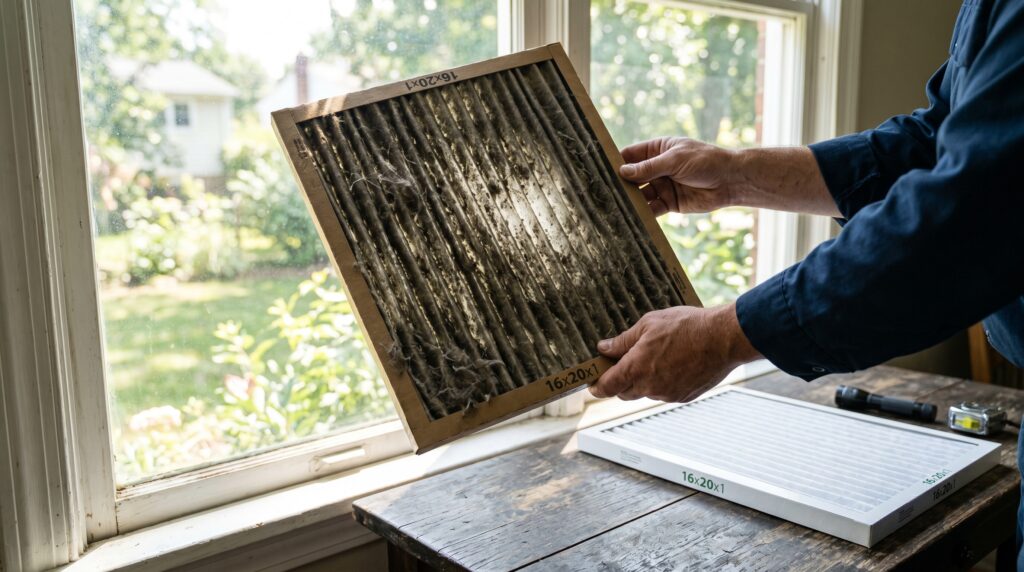
Change That Air Filter
This is the big one. If you do nothing else, do this.
A dirty filter chokes your whole system. Airflow drops. The unit overheats. Bills climb. And all that trapped dust just gets pushed back into the air you breathe.
How often should you swap it?
- Cheap fiberglass filters: every 30 days.
- Pleated filters: every 60 to 90 days.
- Pets or allergies? Check monthly and replace sooner.
One more thing on filters. You’ll see a MERV rating on the box, usually 8 to 13 for homes. Higher catches more dust. But go too high for your system and you starve it of airflow. For most homes, MERV 8 to 11 is the sweet spot. Don’t chase the biggest number.
Write the filter size on the wall by the slot. You’ll thank yourself later. Buy a six-pack so you never have an excuse.
Walk Around the Outdoor Unit
Go look at it. Seriously, walk outside.
Leaves pile up. Grass clippings stick to the fins. Kids leave toys leaning against it. All of that blocks airflow and makes the unit sweat.
Clear a two-foot gap on every side. Pull the weeds. Knock off the debris. Done in five minutes.
Use Your Ears and Your Nose
You know what your system sounds like. When it changes, pay attention.
Grinding, banging, screeching — none of that is normal. A musty smell points to mold in the ducts or drain pan. A burning smell? Shut it off and call someone. Now.
Trust your gut here. You live with this thing. You’ll notice when it’s off.
The Seasonal Checklist
Twice a year you do a bigger pass. Once before summer. Once before winter. Match the work to the season.
Spring: Wake Up the Air Conditioner
Before the first heat wave, prep the cooling side.
- Clean the outdoor condenser. Turn off the power first. Always.
- Hose down the fins gently, from the inside out. Low pressure only. A pressure washer bends the fins and wrecks the unit.
- Straighten bent fins with a cheap fin comb from the hardware store.
- Check the refrigerant lines. The foam insulation on the copper line should be intact. Replace it if it’s cracked or crumbling.
- Test the system on a mild day. Set it to cool. Listen. Feel the vents. Cold air should hit fast.
Catch a weak system in April. Not in the middle of a July heat wave when every tech in town is booked for two weeks.
Fall: Prep the Furnace
Before the cold sets in, switch your focus to heat.
- Swap the filter again. Fresh start for the heating season.
- Test the heat early. Run it fifteen minutes. A burnt-dust smell on the first run is normal. If it keeps stinking, shut it down and investigate.
- Open and clear your vents. Move furniture and rugs off the registers. Blocked vents strain the whole system.
- Watch the flame on a gas furnace. It should burn a steady blue. Yellow or flickering flames mean a combustion problem. Call a pro.
- Test your carbon monoxide detectors. Replace the batteries. This one is non-negotiable.
Do this in October. Not when it’s 20 degrees out and the house won’t warm past 60.
The Annual Deep-Clean Tasks
Once a year, roll up your sleeves. These take longer, but they pay off big.
Deep Clean the Condenser Coils
The seasonal hose-down is light work. Once a year, do it properly.
Kill the power. Pop off the top grille. Vacuum the leaves and gunk out of the inside. Spray a foaming coil cleaner, the kind sold at any hardware store. Let it sit a few minutes, then rinse it out.
Clean coils move heat better. That’s lower bills and a cooler house, plain and simple.
Don’t Forget the Indoor Unit
Everyone obsesses over the outdoor box and ignores what’s inside. Mistake.
Your indoor unit holds the evaporator coil and the blower fan. Both collect dust over time. A dirty evaporator coil can’t pull heat out of your air. A grimy blower wheel moves less air with every spin.
You can vacuum the visible parts and wipe the blower housing yourself. The coil itself is delicate, so go easy or leave the deep work to a tech. Either way, knowing it’s there puts you ahead of most homeowners.
Clear the Condensate Drain Line
This one floods basements. People forget it even exists.
Your AC pulls moisture out of the air. That water drains through a small PVC line. Algae clogs it. Then water backs up and pours onto your floor.
Find the drain line. Pour a cup of distilled vinegar down it every couple of months. For a real clog, a wet/dry vac on the outdoor end sucks the sludge right out.
Recalibrate or Upgrade the Thermostat
Hold your hand near the thermostat a minute. Does the reading match the room? If it’s way off, it needs cleaning or replacing.
Still running an old dial thermostat? Upgrade to a programmable or smart one. It pays for itself fast. You stop heating an empty house at 2 p.m. while you’re at work.
Inspect the Ductwork
Leaky ducts waste up to 30% of your conditioned air. That air leaks into your attic and your walls. You paid to cool it. Now it’s gone.
Look at the accessible duct joints in your basement or attic. Feel for air escaping while the system runs. Seal gaps with mastic or metal foil tape.
And no, regular duct tape does not work on ducts. Ironic, I know. It dries out and peels off within a year. Use the metal foil stuff.

What You Should Leave to a Pro
I’m all for doing it yourself. But some jobs need a licensed tech. Know the line.
Call a professional for:
- Refrigerant. It’s a regulated chemical, and you need certification to touch it. Low refrigerant also means a leak somewhere, which needs a real fix, not a top-off.
- Electrical repairs. Capacitors store a charge that can shock you hard, even with the power off.
- The heat exchanger inspection. A crack here leaks carbon monoxide. A pro checks it safely with the right tools.
- Anything under warranty. DIY repairs can void it. Read the fine print before you grab a wrench.
Book a professional tune-up once a year, twice if you want to be thorough. A good tech catches problems you’ll never spot on your own. It runs $80 to $200 and saves you thousands down the road. Cheapest insurance you’ll ever buy.
Warning Signs You Can’t Ignore
Your system talks to you. Learn the language. Call someone fast if you notice:
- Weak airflow from the vents.
- Rooms that never hit the temperature you set.
- A sudden spike in your energy bill with no change in how you use it.
- Short cycling — the system kicks on and off every few minutes.
- Water pooling around the indoor unit.
- Ice on the refrigerant lines or the coils.
- Any electrical or burning smell.
These aren’t “wait and see” problems. They’re “deal with it now” problems. Caught early, they’re cheap. Left alone, they’re brutal.
Your Simple Year-Round Schedule
Here’s the whole thing on one page. Stick it on the fridge.
Every month:
- Check or change the filter.
- Clear the outdoor unit.
- Listen for odd sounds and smells.
Every spring:
- Deep clean the condenser.
- Test the AC early.
- Check the refrigerant line insulation.
Every fall:
- Test the heat early.
- Inspect the furnace flame.
- Test the CO detectors.
Every year:
- Flush the drain line.
- Seal duct leaks.
- Book a professional tune-up.
That’s it. Follow this and you’ve already beaten most homeowners, who do nothing until something breaks at the worst possible moment.
The Bottom Line
HVAC maintenance isn’t complicated. It’s just consistent.
Change your filter. Keep things clean. Listen to your system. Call a pro once a year and for the jobs that bite back.
Do that, and your unit runs quiet, your bills stay low, and your house stays comfortable through every season. Ignore it, and you’ll meet your HVAC tech a lot sooner than you’d like — and you’ll be writing him a very big check.